How do I create a URL QR code?
Updated September 14, 2026 · 2 min read
In the dashboard click Create new, then Create a QR Code. Choose URL on the Type step, paste your link into Website URL, style the code on the QR Design step and click Download ✓. A dynamic URL code sends every scan to whatever link you have set, so you can point it somewhere else later without reprinting. URL codes can also be made Static, but a static code can never be edited and records no scans.
Video transcript
Here is how to create a URL QR code. Scanners land on whatever link you choose, and you can change that link later without reprinting.
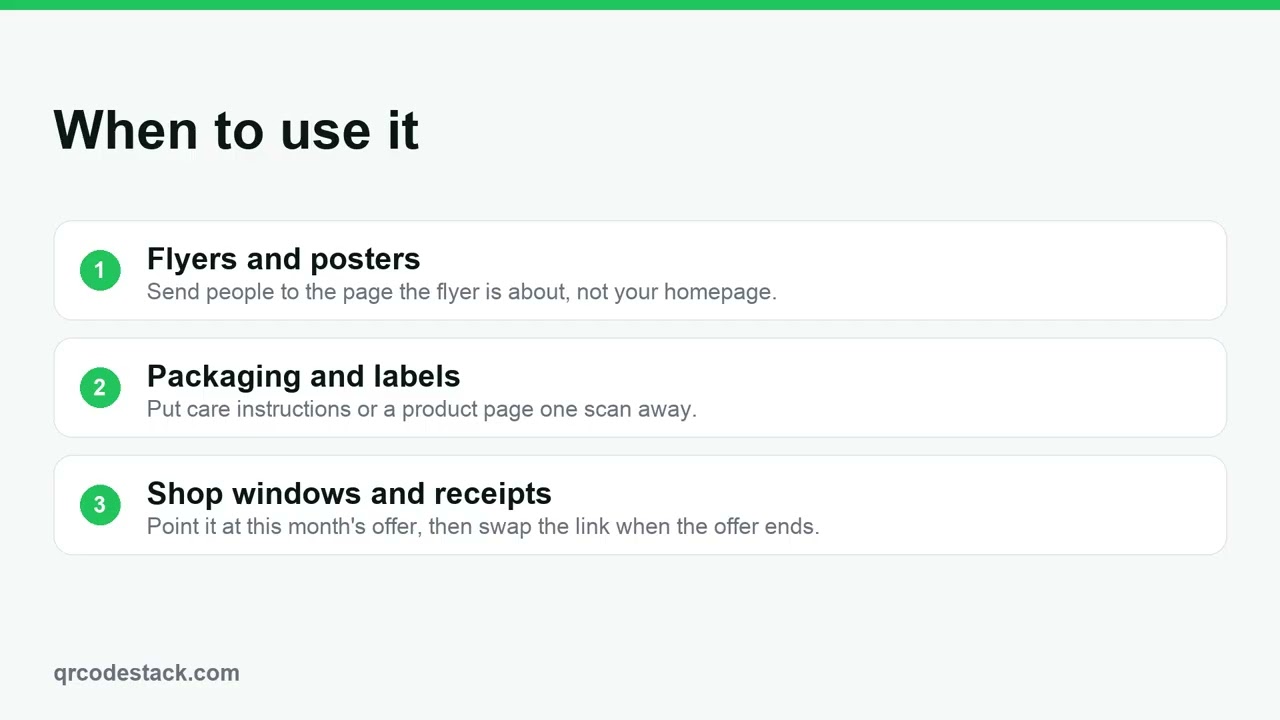
Use it on a flyer that opens the page it is about, on packaging with care instructions, or on a shop window pointing at this month's offer. Because the code is dynamic, you can swap the link later and the printed code keeps working.
In the dashboard, click Create new, then Create a QR Code. Pick URL from the type grid and leave it on Dynamic. Give the code a name, then paste the website URL. Choose a theme for the code itself, then Download. The code is saved and ready to print.
Only the link matters. First, paste the full address, starting with https. Second, give the code a name you will recognise in the dashboard. Third, remember you can edit the link later without printing a new code.
Try it on the seven-day free trial. No credit card, five dynamic QR codes. Link in the description.
When to use a URL QR code
- Flyers and posters. Send people to the page the flyer is about, not to your homepage.
- Packaging and labels. Put care instructions or a product page one scan away.
- Shop windows and receipts. Point it at this month's offer, then swap the link when the offer ends.
Steps in the dashboard
- Open the wizard. In the dashboard sidebar click Create new, then Create a QR Code.
- Pick the type. On the Type step choose URL — it is in the first fifteen tiles, so you will not need More. Leave the toggle on Dynamic unless you want a fixed code.
- Fill in the link. On the Content step paste the address into Website URL. Include
https://— the field is validated and rejects anything that is not a full address. Give the code a QR Code Name too; it is a label for your dashboard and scanners never see it. - Style it. On the QR Design step pick one of the ten Themes, or set your own dots, colours, frame and logo. Keep strong contrast between Dots Color and Background.
- Save and download. Click Download ✓ to create the code. For the image file, open it from My QR Codes, click Download, and pick JPEG, PNG, SVG or PDF in the Save as... dialog.
After you download
The code is now in My QR Codes, where you can rename it, tag it, file it in a folder or copy its short URL.
- Change the content later. Click Edit on the code, change the fields, then click Update ✓. The printed pattern never changes, so nothing has to be reprinted.
- Scans are counted. A dynamic scan passes through us, so the code records device, operating system, browser, referrer and country. Click Full analytics to read them. Cities and the scan map come with the free trial and the Business plan.
- Campaign tracking. On Pro and Business an Edit parameters button appears under the link, opening the UTM Parameters dialog so the destination is tagged for your analytics.
Common problems
The wizard says "Please enter a valid URL"
The field wants a complete address. Add https:// at the front and remove any spaces or line breaks that were picked up when you copied the link.
Scanners still land on the old page
Check whether the code is static: open it and look for the Static QR Code notice on the Content step. Static content is baked into the pattern. On a dynamic code the change only applies once you click Update ✓.
You need different links for different people
Only the URL type offers Dynamic Routing, under Rules & Limits on Pro and Business. It sends visitors to different destinations by country, region, device or platform, and the first matching rule wins.
Frequently asked questions
Can I change the link after printing?
Yes, as long as the code is dynamic. Edit the destination and click Update ✓; the printed pattern keeps working.
What is the difference between URL and Website?
They use the same single-field form. Pick URL if you may later want dynamic routing rules, which are offered on the URL type only.
Does a static URL code give me scan data?
No. A static code encodes the link itself, so the scan never reaches us and there is nothing to count.
How many dynamic codes do I get?
Five on the free trial, 10 on Starter, 50 on Pro and 600 on Business.
Related articles
How do I create my first dynamic QR code?
Click Create new, pick a type, leave the toggle on Dynamic, fill in the content, style it, then click Download. The code is saved with its redirect built in.
How do I edit a QR code's destination after printing?
Open the code, click Edit, change the destination on the Content step and click Update. The printed pattern keeps working. Static codes cannot be edited.
Can I download my QR code as SVG, PDF or another vector format?
Yes. Open the code, click Download, and pick SVG in the Save as... dialog. JPEG, PNG and PDF are there too. Paid plans and the free trial get all four.
How do I send scanners to different destinations by country or device?
Turn on Dynamic Routing in Rules & Limits on a URL code, add If Country/Region/Device/Platform rules, and set the URL each one goes to. Pro and Business.
Static vs dynamic QR codes in QRCodeStack: which should I choose?
Dynamic encodes a redirect, so it can be edited and tracked. Static embeds the content in the pattern: no edits, no analytics, and it needs a paid plan.
Still stuck?
Email support@qrcodestack.com with the email on your account and, if it is about one code, its name or short link. A person replies within one business day, usually sooner.