QR Codes for Retail: Shelf-Edge, Receipts, Loyalty, and Omnichannel Setup
A retail shelf is the most expensive piece of real estate a brand ever buys, but the surface itself is tiny. A few square inches of paperboard between the product and the price tag. QR codes are how you make that surface infinitely larger. A scan can pull up demo videos, fit guides, ingredient stories, sustainability claims, customer reviews, or a coupon. Content that simply cannot fit on the package itself but is exactly what convinces a shopper at the moment of decision.
This is the complete qr code for retail page covering the practical setup for every store environment, from independent boutiques to multi-location chains to national CPG brands selling on someone else's shelves. The shelf-edge talker QR for product reviews, the fitting room QR for size requests, the receipt QR for loyalty signup, the window decal QR for closed-store browsing, the smart mirror QR for outfit recommendations, and the in-store payment landscape (UPI QR in India, Tap to Pay globally) that runs alongside marketing QR but works on different rails.
The Indian retail context that competitor pages miss entirely: DMart shelf-edge patterns, Reliance Retail FreshSign integration, Zudio fitting room QR, Lenskart phygital try-on, Croma electronics demo QR, and the kirana store UPI ecosystem that touches 50+ million unorganised retail shopfronts. Static codes from $9/month, dynamic codes from $9/month with 7-day free trial and full scan analytics.
Why retailers use QR codes in 2026
Four reasons drive QR adoption across modern trade, independent retail, and CPG brands selling through retail channels:
The shelf surface is too small for the modern shopper
A retail package has 30-200 square centimetres of usable surface. That carries branding, regulatory text, barcode, ingredient list, and key product claims. Modern shoppers want fit guides, ingredient stories, sustainability data, video demos, and review counts before they put the product in the basket. None of that fits on the pack. A 15x15mm QR code on the package or shelf-edge talker carries unlimited digital content and removes the surface constraint entirely. The product packaging QR setup goes deeper on the on-pack version of this pattern.
Promotions rotate weekly, packaging runs for years
Retail product packaging stays on shelves for 12-36 months across production runs. During that period, brand teams run weekly promotions, seasonal campaigns, festive offers, regional promotions, and end-of-season clearance. With static printing, every promotion change requires new shelf strips, hangtags, and price talkers. With a dynamic QR code, the destination URL changes once in the dashboard and every printed sticker, hangtag, and shelf strip immediately points at the new offer. The same QR runs Diwali sale promotions in October, Black Friday in November, and everyday loyalty in December.
Per-placement analytics finally exist
Retail has always struggled to measure which shelf signage actually works. Endcap versus shelf-edge, hangtag versus receipt, packaging insert versus window decal. With QR codes, every scan is logged with date, time, device, and rough geographic location. The merchandising team finally knows whether the endcap QR outperforms shelf-edge QR, whether window decals pull foot traffic, and which store locations have the highest engagement. The data drives placement decisions instead of guesswork.
Omnichannel without a development team
A QR code is the cheapest way to bridge in-store and online retail. The shelf-edge QR opens the product detail page with reviews. The out-of-stock QR redirects to the buy-online-pick-up-in-store flow. The receipt QR opens the loyalty programme signup with the SKU pre-attributed. None of this requires a custom mobile app, a new POS integration, or development sprints. The QR is the bridge.
The 10 places QR codes belong in a retail store
The retail qr code toolkit splits across ten distinct placements. Most retailers implement four or five; chain retailers and modern trade leaders often run all ten across their store footprint.
Shelf-edge talker QR
A QR on the shelf strip or shelf-edge talker linking to product reviews, video demos, fit guides, or sourcing stories via a standard URL QR linking to the product detail page. The single highest-scan placement in any retail store because shoppers are actively considering the product at that moment. Standard practice for cosmetics retailers (Sephora, Nykaa), electronics retailers (Croma, Reliance Digital), and grocery chains running QR-tagged shelf marketing.
Hangtag QR for apparel
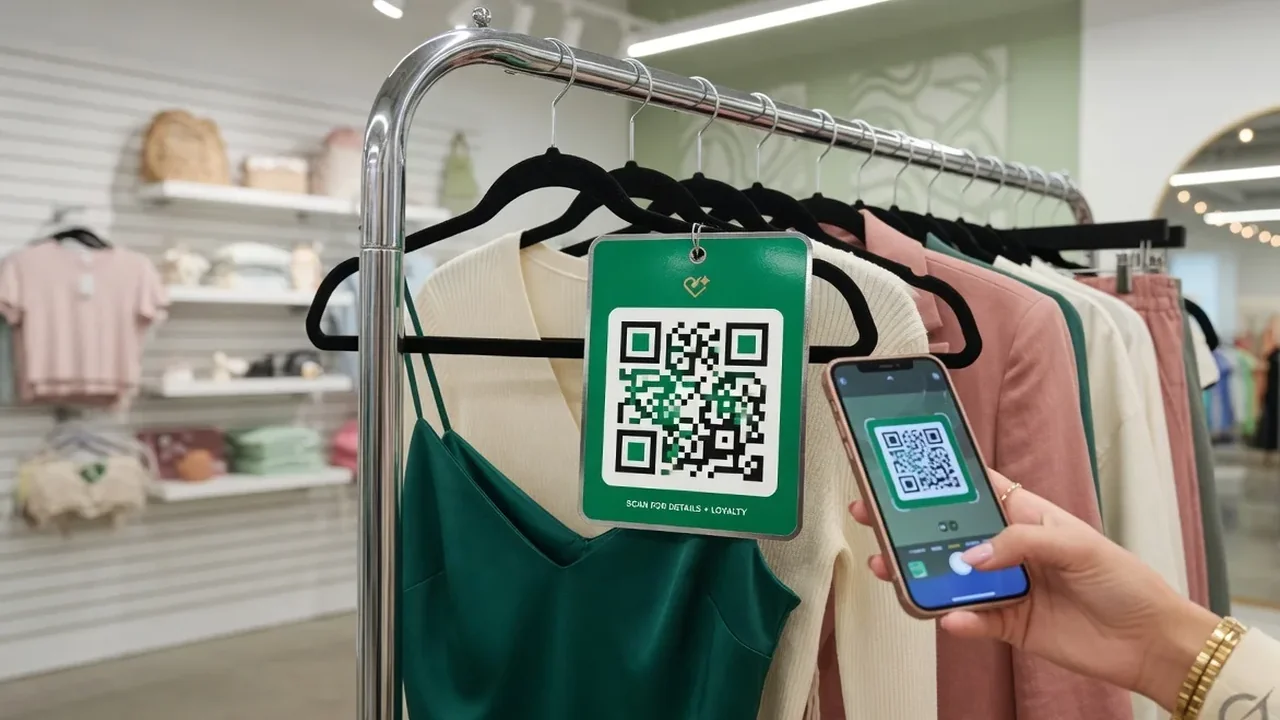
A QR on the price hangtag of garments linking to YouTube styling videos and look books, complete-the-look product pages, sustainability claims, or fitting guides. Used heavily by H&M, Zudio, Trent (Westside), Levi's, Uniqlo, and Indian D2C brands like Damensch, Bewakoof, and Wear Sierra. The hangtag QR is the cheapest possible upgrade to apparel retail merchandising.
Fitting room QR
A QR on the inside wall of the fitting room or on the door that opens a WhatsApp Business chat with floor staff for "request another size or colour" requests. The shopper scans, types the size and colour they need, store staff bring it within minutes. Reduces the friction of leaving the fitting room half-dressed. Used by Uniqlo globally, Zudio across India, and increasingly by Lifestyle and Trent stores.
Window decal QR
A QR on the window facing the street, scannable when the store is closed. Opens the online catalogue, today's offers, or the store hours and location page. For shopping mall locations, often paired with the broader real estate QR setup for leasing and brand expansion content. Captures the after-hours window-shopper who would otherwise lose interest. Particularly useful for high-end retail in city centres where late-night foot traffic is real but stores close by 9 PM.
Receipt QR
A QR printed on the bottom of the customer receipt linking to loyalty programme signup, customer feedback form, or Google Review QR for star-rating capture. The receipt QR is high-intent because the shopper has just purchased and the experience is fresh. Retailers using receipt-moment QR feedback report 3-5x higher review volumes than email-only follow-up.
Loyalty programme signup QR
A QR at the point of sale, on the counter card, or in the shopping bag linking to instant loyalty programme enrollment. Retailers from Decathlon to Lifestyle to Tanishq to Croma all use this pattern. For B2B retail with sales reps on the floor, pair with the business card QR setup so each staff member carries a personal scannable contact. Make the signup form short (phone number + name only) and the QR conversion can hit 30-50% of bag-handle scans.
Click-and-collect QR
A QR on the shelf for out-of-stock SKUs that redirects to the buy-online-pick-up-in-store page for the same product. Often supported by a PDF QR for warranty and product documentation so customers can preview the item details before confirming the pickup order. Never lose a sale because the size or colour ran out before the next delivery. Standard practice for IKEA, Decathlon, and increasingly for Reliance Retail and Pepperfry.
Smart mirror and digital signage QR
A QR on the smart mirror in apparel and beauty retail that opens outfit recommendations, complementary product suggestions, or Instagram social tagging and brand handle following. Used by Nykaa Luxe stores, Sephora flagship locations, and increasingly by Lenskart and Titan Eye+ for phygital try-on experiences.
Self-checkout QR
A QR at self-checkout terminals that opens the payment flow, applies a coupon, or processes a price match. The qr code checkout for retail stores pattern is most developed in DMart, Reliance Retail Fresh, and the international chains like Walmart and Target. Often paired with a WiFi QR for guest network access at self-checkout zones so shoppers with weak mobile signal can complete payment. Often integrated with mobile-wallet payment in India (PhonePe, Google Pay, Paytm) via UPI QR.
Window-to-bag QR continuity
The advanced retailer move: a QR on the window opens the catalogue, the same QR on the in-store shelf-edge opens product reviews, and the same QR on the receipt opens loyalty signup. Counter staff can carry vCard QR cards for direct contact handouts that match the rest of the visual identity. The shopper sees one consistent visual identity (same QR style, same brand) across the full journey. Builds brand cohesion that one-off QR placements never achieve.
QR codes for Indian retail: DMart, Reliance Retail, Zudio, and the kirana ecosystem
Indian retail has unique QR patterns that don't apply globally. Five worth covering:
Modern trade chains
DMart, Reliance Retail Fresh, BigBazaar legacy stores, Vishal Mega Mart, More Retail, and Spencer's are the dominant grocery and household-goods chains. Their QR usage runs heavy on shelf-edge price talkers, weekly offer signage, and loyalty programme enrollment. DMart specifically uses QR codes on the back of the receipt for membership signup; Reliance Retail uses QR on shelf-edge for AJIO Fresh online cross-sell.
Fast fashion and apparel retail
Zudio (Tata Trent), Westside, FabIndia, H&M India, Max Fashion, and Pantaloons all use QR on hangtags for styling content and sustainability stories. Zudio specifically uses fitting room QR for size and colour requests in their high-traffic locations. Westside uses hangtag QR for the Trent loyalty programme. FabIndia uses on-pack QR for artisan and craft sourcing stories.
D2C retail expansion
Indian D2C brands have heavily adopted retail QR as they expand from online to physical stores. BoAt opening BoAt Lifestyle stores uses QR for warranty registration and product demo videos. Sleepy Owl coffee opens cafes with QR-driven menu, ordering, and recipe content. Mamaearth, Plum Goodness, and Wow Skin Science use shelf-edge QR for ingredient stories in their Nykaa retail partnerships. The on-pack content QR pattern is covered in depth on the packaging page for these D2C brands.
Premium retail and authentication
Tanishq jewellery uses QR codes on tags for diamond certification and authenticity verification, generated via the bulk QR generator for unique per-product authentication codes. Caratlane uses QR for product details and AR try-on. FabIndia uses QR for organic certification on textile pieces. Forest Essentials uses pack QR for ingredient sourcing. These are real authentication patterns where the QR carries serious credibility weight, not just marketing content.
Kirana store ecosystem and UPI QR
India has 12-13 million unorganised retail outlets (kirana stores). Their QR usage is dominated by UPI payment QR codes (Bharat QR, BHIM, PhonePe Business QR, Paytm For Business, Google Pay For Business). This is separate technology from marketing QR codes (UPI QR is issued through NPCI-approved channels and accepts payment, while marketing QR opens a destination URL). However, the kirana QR ecosystem has trained Indian consumers to scan codes confidently. Adoption rates for marketing QR codes in India benefit directly from the UPI QR familiarity. A retail QR strategy in India should acknowledge UPI is the dominant scan context but position marketing QR as the engagement layer that runs alongside.
Real retail QR campaigns worth studying
Five named campaigns that show what works:
Uniqlo hangtag QR with styling content
Uniqlo globally has used hangtag QR codes since 2020 to link garments with styling videos, complete-the-look product pages, and care instructions. The hangtag QR became standard apparel retail practice after Uniqlo demonstrated 15-25% scan rates at point of purchase. India and Singapore stores both run this pattern.
Sephora shelf-edge QR with reviews and tutorials
Sephora (and Nykaa Luxe in India following the same pattern) uses shelf-edge QR codes on cosmetics displays linking to product reviews, application tutorials, and shade-match guides. The shelf-edge QR specifically targets the cosmetics-aisle "I don't know which shade" friction point that turns browsers into walk-aways. Scan rates report at 8-15% of shelf interactions.
IKEA AR room placement QR
IKEA's instructions catalogue QR codes link to augmented reality room placement experiences where the shopper points their phone at their living room and sees the IKEA sofa overlaid in their space. The AR QR turned a furniture-buying decision (size, fit, colour match) into a 30-second mobile experience. The pattern has been copied by Pepperfry, Urban Ladder, and the IKEA-India stores in Hyderabad and Bangalore.
DMart receipt QR for membership signup
DMart receipts print a QR at the bottom linking to DMart Ready (the e-commerce arm) membership signup, with the in-store purchase pre-attributed for loyalty points. The pattern converts in-store shoppers into omnichannel shoppers at near-zero acquisition cost. The DMart QR receipt has become a model for Indian modern trade.
Tanishq jewellery authentication QR
Tanishq prints QR codes on jewellery hangtags linking to certificates of authenticity, diamond grading details, and care instructions. The QR carries genuine purchase-decision weight in a category where authenticity is a real concern. Pattern is replicated by Kalyan Jewellers, Joyalukkas, and Malabar Gold.
Designing retail QR codes for high-traffic environments
Three rules determine whether the QR earns its placement in a retail environment:
Size
Minimum 15x15mm for shelf-edge talkers and hangtags. Minimum 25x25mm for counter cards and receipts. Minimum 50x50mm for window decals and lobby signage. The qr code retail size rule scales with scan distance: closer scans need smaller codes, distant scans need larger codes.
Placement priority
- The shelf-edge talker is the highest-scan placement for product engagement (shoppers are actively considering).
- The hangtag is the second-highest for apparel because shoppers handle the garment closely.
- The receipt is highest-scan for post-purchase actions (loyalty, review, feedback).
- The window decal is moderate-scan but uniquely valuable for after-hours capture.
- The fitting room QR has very high conversion despite lower scan volume.
- The endcap and aisle-end signage performs poorly compared to product-adjacent placements.
Quiet zone and lighting
Retail lighting is variable. Bright supermarket fluorescents, dim boutique mood lighting, high-glare display cases. The QR needs to scan in all three. Use higher-contrast options (true black on true white) and maintain at least 2-3mm of white quiet zone around the QR even in dark-theme branding. Test the printed QR from 3 different phones in 3 lighting conditions before approving the print run. For brand teams designing in-store signage through Canva, the QR code Canva integration streamlines the workflow from generator to print-ready artwork.
Common retail QR mistakes
Six mistakes that waste the retail QR investment:
QR pointing at the brand homepage
The most common failure. Shopper scans the shelf-edge QR and lands on a generic brand homepage. They have to navigate to find the actual product. Conversion drops by 60-80%. Always link to the specific page that matches the QR's placement.
Static QR for time-sensitive promotions
Promotions rotate weekly. Static QR locks the destination forever. When the Diwali sale ends and the Christmas promotion starts, the QR still points at the expired Diwali page. Use dynamic QR for any time-bounded promotion.
QR without a caption or call to action
"QR with no caption" loses 30-40% of potential scans. Shoppers don't know what they'll get on the other side. Add a clear single-line caption: "Scan for product reviews", "Scan for 20% off", "Scan to join loyalty", "Scan for styling videos".
QR placed where shoppers don't look
Behind the price tag, under the shelf, on the bottom of the package, inside the bag. These placements get near-zero scans. Stick to high-attention surfaces: shelf-edge talker, hangtag front, receipt bottom, fitting room mirror, counter card.
Untested QR before mass print run
A 10,000-hangtag reprint after discovering the QR doesn't scan reliably is a real expense. Test the printed QR from 3 different phones (iOS, Android, older device) in 3 lighting conditions (bright store, dim corner, mid-light) before approving the mass print.
Confusing marketing QR with UPI payment QR
A specifically Indian mistake. Some retailers place a marketing QR (link to product page) next to a UPI payment QR (link to payment) without clear labelling. Shoppers scan the wrong one and abandon. Label clearly: "Scan to PAY" for UPI QR, "Scan for product info" for marketing QR. The two ecosystems are separate technologies.
Frequently Asked Questions
How can retailers use QR codes?
The qr code retail toolkit spans the full store environment: shelf-edge talkers for product reviews, hangtag QR for apparel styling content, fitting room QR for size and colour requests, receipt QR for loyalty signup, window decal QR for after-hours browsing, smart mirror QR for outfit recommendations, click-and-collect QR for out-of-stock SKUs, and broader packaging QR for on-pack content. A typical full-service retailer uses 5-7 different QR codes; modern trade chains often run 8-10.
What is the best qr code solution for retail global rollout?
Look for five capabilities: dynamic codes (so destinations can be updated across seasonal promotion cycles), real-time scan analytics broken down by store location, bulk generation for unique SKU-level or store-level QRs, brand customisation (logo embed, colour matching), and country and region routing rules so one printed code sends a scan in each market to that market's storefront, currency, and language. The best qr code solution for retail global deployment supports all five. QRCodeStack starts at $9/month with a 7-day free trial; routing rules are included from the Pro plan up.
How to choose a qr code generator for retail?
Three filters to apply when working through how to choose a qr code generator for retail. First, dynamic capability (any platform requiring static codes is wrong for retail). Second, bulk generation (you'll need hundreds or thousands of unique codes for shelf-edge talkers across SKUs and locations). Third, real-time analytics (you need per-placement scan data, not monthly aggregates). Most retail-focused QR generators handle these basics; the differentiator is pricing structure and brand customisation depth.
What is qr code payments for retail?
QR code payments for retail in India means UPI QR (Bharat QR, BHIM, PhonePe Business QR, Paytm For Business, Google Pay For Business). The customer scans a QR at the counter, their UPI app opens, they confirm payment, the merchant receives the amount instantly. This is separate technology from marketing QR codes; UPI QR is issued through NPCI-approved channels. Internationally, "QR payment for retail" usually means platform-specific QR pay (Apple Pay, Google Pay QR, Alipay+ for cross-border merchants). Marketing QR codes (like the ones generated through QRCodeStack) work alongside payment QR but serve different purposes.
What is qr code checkout for retail stores?
Self-checkout terminals that use QR codes to identify the customer, apply loyalty discounts, and process payment. The shopper scans a personal QR (often from a retailer app) to identify themselves at checkout, then the terminal QR for payment. Most developed in DMart, Reliance Retail Fresh, Walmart, and Target. The pattern has accelerated since 2022 across Indian and global retail.
Can I track in-store QR scans?
Yes. Dynamic QR codes record total scans, unique scans, scan times, device types, and rough geographic location. Retailers use this to compare placements (shelf-edge versus endcap, hangtag versus receipt), to right-size signage investment, and to justify merchandising decisions to corporate. The qr code retail analytics dashboard shows per-store, per-placement, and per-time-window engagement.
What size should a retail QR code be?
For hangtags and shelf-edge talkers: 15x15mm minimum (shoppers scan from close range). For counter cards and receipt prints: 25x25mm minimum. For window decals and lobby signage: 50x50mm minimum. Always include 2-3mm of quiet zone around the QR.
Can I update a printed QR if the promotion ends?
With a dynamic QR, you change the destination URL from the dashboard in under 30 seconds. Every printed sticker, hangtag, and shelf-edge talker reflects the new content on next scan. When Black Friday ends, point the same QR at your everyday loyalty page. When a product is discontinued, redirect to a similar SKU. The printed material stays in service through every promotion cycle.
What is the best qr code tool for retail and brick and mortar?
Look for retail-specific features: bulk generation (for unique SKU-level codes), dynamic destinations (for seasonal promotion rotation), brand customisation (for on-pack and on-shelf design integration), real-time analytics broken down by placement, and high-resolution PNG/SVG export for commercial print runs. The best qr code tool for retail and brick and mortar use cases supports all of these. QRCodeStack handles them at $9/month dynamic or $9/month.
How do Indian retailers use QR codes differently from US retailers?
Indian retailers emphasise four patterns less common in US retail: UPI QR for payment alongside marketing QR (clear labelling needed to avoid confusion), WhatsApp Business QR for direct customer service (rather than email or call), regional language landing pages served by region-based routing rules (one code, with a scan in Tamil Nadu opening the Tamil page and a scan in West Bengal opening the Bengali one), and modern trade chain integration with online platforms (DMart Ready, Reliance Retail to AJIO). The kirana store ecosystem touches 12-13 million unorganised retail outlets and has trained Indian consumers to scan QR codes confidently.
QR types you'll use across retail operations
Retail QR campaigns typically use 5-8 different QR types across the store footprint. Common combinations:
For F&B retail and pop-up cafes inside larger stores, the menu QR setup for live ordering handles the food-and-drink side of mixed retail formats.
For static product information that never changes (such as a permanent care-instruction page or warranty document), a plans from $9/month works without any subscription.
Related verticals worth exploring: the marketing campaigns guide covers broader brand campaign integration, the restaurants and F&B page covers full-service food retail operations, and the events and pop-up activations page covers retail launch events and conferences.
For full QR pricing tiers across static and dynamic options see the plan and pricing comparison, or browse all 40+ QR formats supported to map every retail touchpoint to its right code type.
Roll QR codes out across your retail floor
Retail QR codes are no longer optional infrastructure. They are the bridge between every shelf, hangtag, fitting room, and receipt in your store and the digital content that runs underneath. Product information, promotions, loyalty enrollment, customer feedback, omnichannel pickup, payment, authentication: each one is a QR placement away from being seamless instead of friction-filled.
Pick the next moment in your store where shoppers are currently struggling: typing a product URL, asking for a different size, finding the loyalty signup form, locating the warranty information. Map that moment to a QR placement. Generate the code in 20 minutes. Print once and the QR will keep working through every promotion change, every seasonal update, every product launch, until the store is rebranded.
Rolling out across stores or SKUs? Book 20 minutes with us.
Dynamic codes from $9/month with a 7-day free trial and full scan analytics.