Free Pet ID QR Code Generator
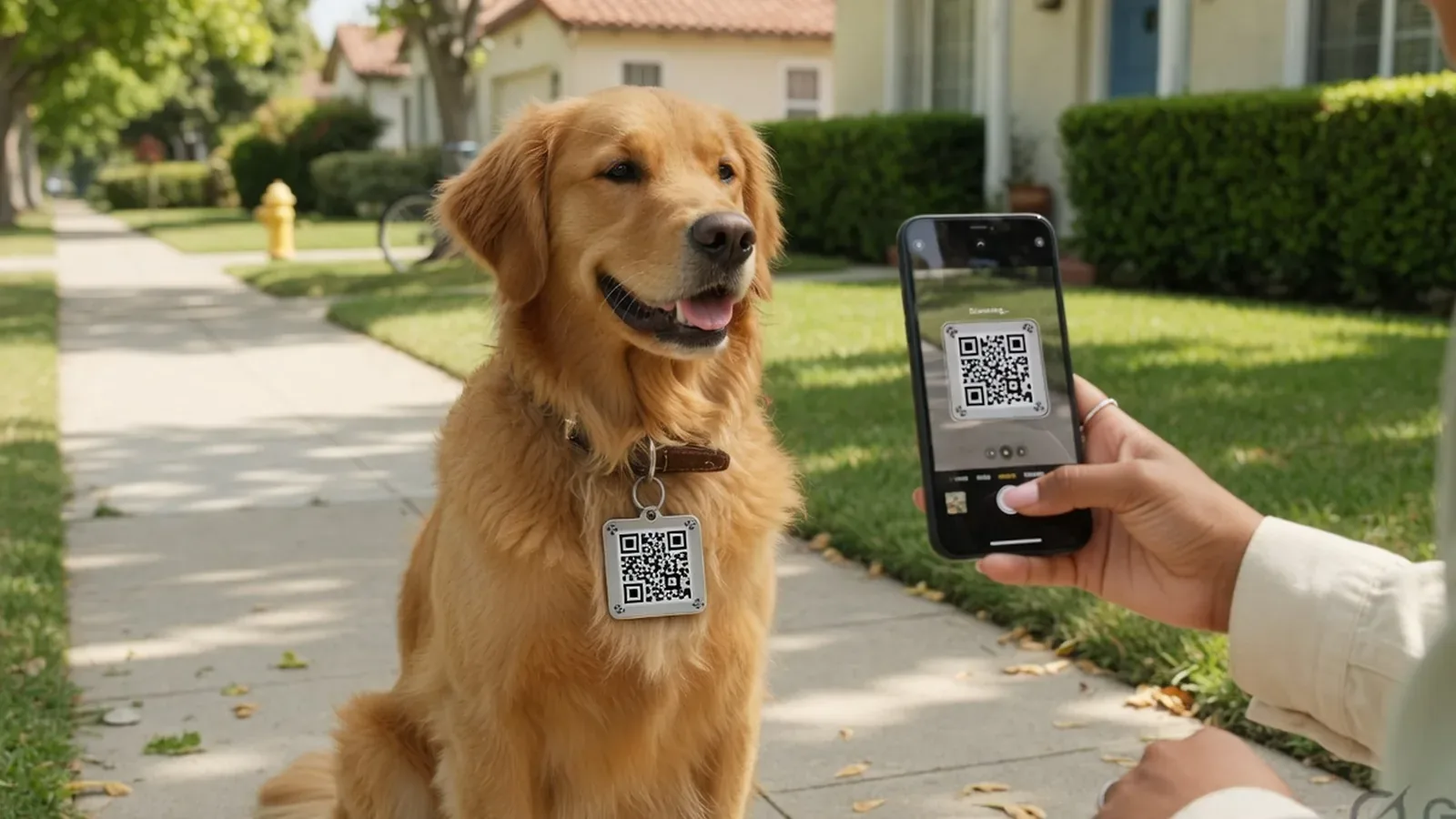
Make a pet ID QR code for your dog or cat's collar tag. Whoever finds them points a phone camera at it and sees your name, your number, your vet, and anything they need to know — medication, allergies, "nervous around strangers". No app to install, no account for them to make. Just your number on their screen in about three seconds.
Editable forever. Change your phone number without buying a new tag.
Works with any phone camera • Static $9/month • Dynamic from $9/month
What is a pet ID QR code?
A pet ID QR code is a scannable code on your pet's collar tag that opens a web page about them. An engraved tag fits a name and one phone number, and that number is wrong the moment you change it. A QR code pet tag holds as much as you want — two contacts, your vet, a photo, medical notes — and you can rewrite all of it later without touching the tag.
Here is what actually happens when a dog gets out. A neighbour two streets over finds them wandering, with no idea whose they are. They are not going to drive to a vet to have a microchip read. They will look at the collar. If the tag has a QR code, they point their camera at it, and your phone rings a minute later. That is the entire job of a digital pet tag: shorten the distance between "someone found your dog" and "you are on the phone with them".
One thing to be clear about, because it is the most common misunderstanding: this is not a tracker. It has no GPS and no battery, and it does nothing at all until a human being finds your pet and scans it. What it does is make that human's next step obvious.
What goes on a pet QR code profile
A digital pet ID tag can hold far more than an engraved one, but more is not always better. You choose which fields to fill in, and it is worth writing the profile for a stranger holding your pet in the street, in a hurry, on someone else's phone.
Your phone number
The one field that matters most. Add a second contact too — a partner, a flatmate, a parent — because you will not always pick up.
A photo of your pet
So the finder knows they have the right animal, and so you can share a real listing if they go missing for longer than an afternoon.
Name, breed and age
A dog that hears its own name calms down fast. Breed and age help a shelter log them correctly if it comes to that.
Your vet's details
The fallback when you do not answer. A finder who cannot reach you can call the practice, and the practice knows who you are.
Medical notes and medication
Diabetic, epileptic, on daily medication, allergic to something common. If your pet needs a dose tonight, the person holding them needs to know tonight.
Vaccination records and documents
Rabies date, vaccination card, microchip number, pedigree paperwork. Useful far beyond emergencies — boarding kennels, groomers, airlines and landlords all ask, and it is easier to hand over a scannable link than dig through a drawer.
One thing to leave off: your home address. Anyone who scans the tag can see the profile, including someone who has your pet and should not. Your phone number is enough to arrange a meeting point.
Static or dynamic pet QR code?
For most QR codes this is a genuine trade-off. For a pet tag it mostly is not, and it is worth saying why plainly.
Static pet QR code
Your details are baked into the QR pattern itself. It works forever with no subscription, but nothing can ever be changed. Change your phone number and the tag on your dog's collar is now pointing at a dead number — and you will not find out until the day it matters. Reasonable if you are printing a temporary tag for a holiday or a foster placement. Not what we would put on a collar long term.
→ Start a free trialDynamic pet QR code
The QR on the tag never changes; the profile behind it lives in your dashboard. New phone number, new vet, new address, a medication that started last month — edit it once and every future scan shows the update. The tag you engraved in 2026 is still correct in 2031.
You also see every scan — the time, and the location it happened, pinned to coordinates on a map when the finder allows it. On an ordinary day that is a curiosity. On the day your dog is missing, it is the only signal you have. From $9/month with a 7-day free trial.
→ Start a dynamic plan free for 7 daysLearn more: static vs dynamic side by side.
If your pet goes missing: what a scan tells you
A QR tag is not a tracker — nothing happens until a person scans it. But the moment somebody does, that scan is recorded, and on the day your pet is missing it is the most useful thing you have.
Where the scan happened
If the finder allows the location prompt on their phone, the scan is pinned to actual coordinates on your map — usually accurate to a street. If they decline, you still get the approximate area from their network connection. Either way you learn which direction to search.
When it happened
Every scan is timestamped. A scan twenty minutes ago means somebody has your pet right now and is looking at your number. That alone changes what you do next — and it is the difference between searching and waiting by the phone.
A trail, if there is more than one
Several scans across an afternoon plot as points on a map. Two scans a kilometre apart tell you your dog is moving and roughly which way. A cluster in one spot usually means somebody has taken them in and is deciding what to do.
Being straight about the limits. This is not live tracking and it should not be relied on as if it were. There is no signal until somebody scans, the precise location depends on that person tapping "allow" on their own phone, and a pet nobody has found produces no data at all. It tells you what happened, not where your pet is this second. For live location you need a GPS tracker — and if your pet is genuinely missing, still call your vet, the local shelters and the microchip registry. The scan log is a strong lead, not a substitute for any of that.
Where a digital pet tag earns its keep
Getting a lost dog home is the obvious one. It is not the only one.
The dog that slipped the gate
The everyday case. Someone a few streets away has your dog and wants to give them back but has no idea who to call. The tag answers that in one scan.
Boarding, sitters and dog walkers
Instead of a page of handover notes, point them at the tag. Feeding, medication, vet contact and your number are all in one place they cannot lose.
Vet visits and emergencies
A locum seeing your cat for the first time can scan the tag and read the history, medication and vaccination dates without waiting on records.
Travel and relocation
Airlines, quarantine desks and new landlords all want vaccination proof. Keep the paperwork on the profile and update the contact number when you move country.
Shelters, fosters and rescues
Animals move between foster homes and the paperwork rarely keeps up. A tag whose profile can be reassigned travels with the animal instead of the household. Ask us about bulk codes if you run a rescue.
Multi-pet households
Three dogs, three tags, three profiles, one dashboard. Change your number once and it updates on every collar in the house.
How to make a pet ID QR code
Three steps, about two minutes:
Fill in the profile
Your pet's name and photo, your phone number, a backup contact, your vet, and any medical notes. Everything is optional except a way to reach you.
Download the QR
PNG if you are printing a sticker. SVG if an engraver is cutting it into metal — it stays sharp at any size. See the printing guide for sizes and materials.
Put it on the collar
A sealed sticker on an existing tag works, or send the file to any engraver. Scan it yourself from two feet away before it goes on, then re-test every few months.
Two practical notes, because a dog QR code tag lives a harder life than most printed codes. Keep the printed code at least 2cm across — collar tags are small and phone cameras need something to lock onto. And generate at the highest error correction, so the code still reads once the tag has been dragged through a hedge a few hundred times. If a code stops scanning, the troubleshooting guide covers the usual causes.
Frequently Asked Questions
How do I make a pet ID QR code?
Open this pet ID QR code generator, fill in your pet's name and photo, your phone number, your vet's number, and any medical notes. Click Generate and download the QR as PNG or SVG. Print it on a sticker or send the file to a tag engraver. The whole process takes about two minutes.
Does a pet QR code tag track my pet's location?
Not continuously. A QR tag has no GPS chip and no battery, so it produces nothing until a person finds your pet and scans it. What it does record is each scan: the time, and where that scan happened. If the finder allows the location prompt on their phone, the scan is pinned to actual coordinates on your map; if they decline, you get the approximate area from their network. So you get point locations at the moments somebody scanned, not a live trail. For live location you need a GPS tracker, which is a separate device.
Can I see where my lost pet was scanned?
Yes, on a dynamic code. Every scan appears in your dashboard with a timestamp and a location on a map. Precision depends on the finder: if they tap allow on their phone's location prompt the pin is usually accurate to a street, and otherwise it is approximate from their network connection. Several scans across an afternoon plot as separate points, which can show you which way your pet is moving. It is a strong lead, not live tracking, and it is no substitute for calling your vet, local shelters and the microchip registry.
Does the person who finds my pet need an app?
No. Any modern phone camera opens the profile straight in the browser. That matters, because a stranger holding a lost dog will not stop to install anything. The profile is a plain web page that loads in a second.
Can I change my phone number without buying a new tag?
Yes, on a dynamic code. The QR printed on the tag never changes, but the profile behind it lives in your dashboard. Change your number, move house, or switch vet, and the next person to scan sees the current details. This is the main reason a dynamic code suits a pet tag: an engraved phone number is wrong the day you change it.
What should I put on a pet QR code profile?
At minimum: your pet's name, your phone number, and a backup contact. Then a photo, so the finder is sure they have the right animal, and your vet's number, so they can call someone if you do not answer. Add medical notes if your pet needs medication, has allergies, or is nervous around strangers. Skip your home address unless you are comfortable with any finder seeing it.
Is a QR tag a replacement for a microchip?
No, they do different jobs and work well together. A microchip is permanent and can only be read by a vet or shelter with a scanner. A QR tag can be read instantly by any neighbour who finds your dog in the street, which is where most recoveries actually happen. Keep the chip registered and add the tag on top.
Will the QR code still scan if the tag gets scratched?
Usually. QR codes carry error correction, so a code can still be read with part of its surface damaged. On a pet tag it is worth generating at the highest error correction and keeping the printed code at least 2cm across, because collar tags take a beating. Test the scan again every few months.
Do I need a subscription for a pet QR code?
Static codes encode details permanently and cannot be edited after creation. A dynamic code, which is the one worth having on a collar, starts at $9/month with a 7-day free trial and lets you update the profile forever.
Related QR codes
Other formats built around a profile page or a set of contact details:
vCard QR Code
Saves contact details straight into a phone's address book with one scan.
Multi-Link QR Code
One code, several destinations — useful if you want a longer profile page.
File QR Code
For vaccination cards, pedigree paperwork and vet records as downloadable files.
QR Codes for Healthcare
How clinics and practices — including veterinary ones — use QR codes day to day.
New to this? Read the full guide to pet QR code tags — how they compare with GPS trackers and microchips, and what to put on the profile.
Or explore the full QR code type library (40+ formats) →Make the tag before you need it
Two minutes now, and the next person who finds your dog knows exactly who to call. Update your number, your vet or your address any time — the tag on the collar never has to change.
Dynamic codes from $9/month with a 7-day free trial and full scan analytics.