QR Code Gamification: Spin-the-Wheel & Scratch Cards That Turn Scans into Sales
Published July 28, 2026 · MARKETING · 10 min read
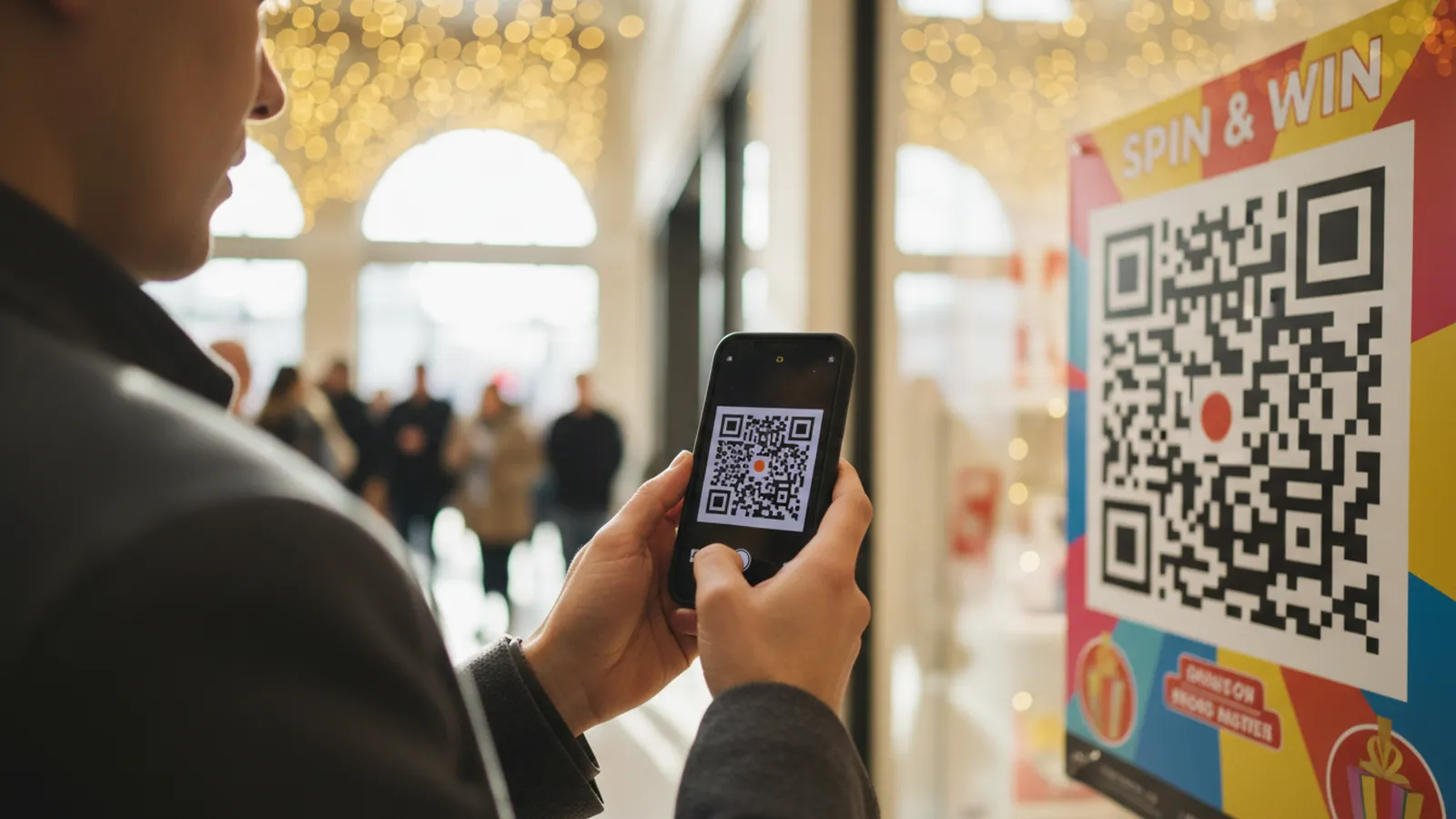
QR code gamification means putting a game behind the scan: a customer points their camera at a code, and instead of landing on a static page, they get a spin-the-wheel or scratch card with a real prize on the line. It works because uncertain rewards are more compelling than guaranteed ones, and it converts because a chance at winning is a better trade for attention than "visit our website."
Industry studies report gamified popups and interactive offers converting in the 9–13% range, versus 2–4% for static equivalents. Some vendors claim campaign conversion rates as high as 40% — treat that as a vendor claim, not a benchmark — but even the conservative numbers are a 3x lift over a plain coupon page.
Below: why the psychology holds up, five playbooks, how to design the odds without giving away the store, and the legal lines not to cross. We'll use QRCodeStack's new Game QR type as the how-to vehicle: scanning opens a spinner wheel or scratch card on a mobile page, no app and no coding required.
Why Gamification Works (the Honest Version)
The mechanism is variable reward. Behavioral research shows uncertain rewards trigger a stronger dopamine response than predictable ones — the same effect that makes slot machines compulsive. When a customer spins a wheel, the anticipation between tap and result does more psychological work than the prize itself.
Worth stating plainly: you're borrowing a powerful mechanic. Used well — small stakes, real prizes, one play per person — it's a fun exchange customers genuinely enjoy. Used badly (rigged wheels, prizes nobody receives), it burns trust and can cross legal lines. More on that below.
Big brands have validated the format at scale. Burger King has run QR lucky-draw promotions printed on meal packaging, and PepsiCo has used spin-wheel and mystery-box mechanics on festive cans. The 2026 pattern everyone is copying: "scan to win" stations at trade shows, plus QR scavenger hunts that move foot traffic around a venue.
Three more reasons the format earns its keep: a game is a reason to scan ("scan to win a dessert" beats "scan for our menu"); every play is a first-party interaction on a page you control, so you can measure and retarget it; and the prize is a coupon, so the game ends at a redemption you can count at the till.
5 QR Gamification Playbooks
Each of these maps to a Game QR with a specific prize table. Concrete setups below.
1. Retail: Spin-to-Win at the Receipt or Counter
Print a spin-to-win QR code on receipts, or put a small standee at checkout: "Spin the wheel — everyone wins something." Prize table: 10% off next visit (heavy weight), free accessory under $5 (medium), 25% off (light), one hero prize like a $50 gift card (very light). The customer spins, wins a coupon code, taps to copy it, and now has a dated reason to come back.
This is a return-visit machine: the coupon only costs margin if they actually return. Works for any retail QR setup.
2. D2C Packaging: the Lucky Draw in the Box
Put a QR code lucky draw on the packaging insert or the box itself — the Burger King move, scaled down for D2C. "Scan inside for your mystery prize." Prizes: discount on the next order, a free sample with next purchase, early access to a launch, one big-ticket winner per month.
Two things make this powerful for D2C: packaging reaches the one audience ads can't cheaply reach — verified purchasers — and an unboxing game gets photographed and shared. If you're already printing QR codes on product packaging, a game turns a compliance element into a retention channel.
3. Restaurants: Scratch Card on the Table
A scratch card QR code on a table tent: "Scratch to reveal your table's prize." Diners scan, swipe to scratch on their phone, and reveal a free dessert, a free appetizer next visit, or 15% off today's bill. One play per device means a table of four gets four plays — exactly the group moment you want.
Skew the prize table toward low food cost, high perceived value (dessert, coffee, a side): the free dessert that costs you $1.20 routinely turns a $40 table into a $52 one. Pairs naturally with the rest of your restaurant QR stack.
4. Events and Trade Shows: Scan-to-Win at the Booth
A big "SPIN TO WIN" sign pulls people to your booth better than any candy bowl. Prizes: branded swag (heavy weight), a premium giveaway (medium), a free month of your product (medium), one grand prize for the show (single-digit weight). Staff watch the spin, hand over the swag, and start the conversation while the confetti is still on screen.
Because it's a dynamic QR, you can see how many booth visitors scanned each day and adjust. Full playbook in our guide to QR codes for conferences and trade shows.
5. The Review-Then-Play Combo
Ask for a Google review, and make the game the thank-you. A card or post-purchase email says "Leave us a review, then spin the wheel on us" — your Google review QR code first, then the game QR as the thank-you step.
One hard rule: never make the reward conditional on a positive review. Incentivizing only 5-star reviews — or gating who sees the review link by sentiment — violates Google's policies and can get your reviews removed. The safe structure: everyone gets the same review link and the same game, regardless of what they wrote. You're rewarding the act of feedback, not the score.
Designing the Odds: Weights and Prize Economics
This is where campaigns are won or lost, and it's why QRCodeStack's Game QR gives every prize a weight — you control the exact odds, and the editor shows the live win-percentage as you adjust. No spreadsheet math.
Four rules that hold up across all five playbooks:
Cap the hero prize hard. Give the $50 gift card a 1–2% weight, then multiply by expected scans before publishing. 1,000 scans at 2% is potentially 20 gift cards — $1,000 of liability. At 0.5%, it's ~$250. The live win-% display exists so you sanity-check this before it's on 5,000 boxes.
Decide: everyone-wins or win/lose. Everyone-wins (the lowest tier is a small discount, not a loss) maximizes goodwill and redemptions — right for retail and restaurants, where the "prize" is really a bounce-back offer. Win/lose makes wins feel earned and prizes feel scarce — right for trade shows and hero-prize draws. The Game QR supports both, with custom win and lose messages.
Price prizes at cost, weight by margin. A free dessert at $1.20 food cost can carry a 30% weight. "25% off entire order" should not. Sort prizes by true cost, assign weights inversely.
One play per device is your budget's seatbelt. Without it, one person spins until they hit the hero prize. It's enforced by default for a reason.
Setting Up a Game QR in QRCodeStack
The Game QR type just shipped on QRCodeStack. Setup takes about five minutes:
- Open the dynamic QR generator and pick the Game type.
- Choose your mechanic: spinner wheel or scratch card. (Slot machine, quiz, and mystery box formats are on the way.)
- Add up to 8 prizes — each with a label, an optional coupon code, and a weight. The editor shows the live win-% for every prize as you tune the numbers.
- Write your win and lose messages, and set the CTA button (e.g., "Redeem at checkout" linking to your booking page or store).
- Publish and download the code. Scans open the game instantly in the mobile browser — winners get confetti, a tap-to-copy coupon code, and your CTA. One play per device is enforced automatically.
No app, no developer, and — unlike some competitors' scan pages — no ads wedged between your customer and their prize.
Measuring It: From Plays to Pipeline
A game QR is a dynamic QR, so every scan is logged: totals, uniques, time of day, device, location. That answers the operational questions — which table tent, which SKU, which show day performed. New to this? Start with tracking QR code scans.
The bigger unlock: everyone who plays is a warm, physically-present prospect, and on QRCodeStack (Pro and up) the scan page can fire a named Meta pixel event carrying the QR's name and ID. Your spin-to-win players become a custom audience in Meta Ads Manager, and coupon-winners can be retargeted with "your code expires Friday" ads. Full setup — including the ~100-person minimum before a custom audience serves — in our QR code retargeting guide.
The Legal Note (Read This Before You Print)
Prize promotions are regulated, and rules vary by country and by US state. This isn't legal advice, but three principles keep most campaigns on the safe side:
- Avoid creating a lottery. In most jurisdictions, a promotion combining a prize, chance, and payment to enter is a lottery — and lotteries are restricted. That's why "no purchase necessary" wording exists: a genuine free entry route keeps a chance-based game a promotional sweepstake in many places.
- Keep prizes as marketing incentives. Discounts, free menu items, swag, and gift cards tied to your own business are the low-risk zone. Cash prizes and anything resembling gambling raise the compliance bar sharply.
- Publish the basics. Clear terms, an end date, prize descriptions, eligibility. Some countries require registration for draws above certain values.
Running a high-value draw or operating across borders? Spend an hour with local counsel before you spend the print budget.
FAQ
Are QR code games legal?
Generally yes, when structured as a free promotional game — no payment required to play, real prizes, clear terms. Problems arise when a game combines chance, a prize, and a required purchase, which can classify it as a lottery in many jurisdictions. Use no-purchase-necessary language where required and check local rules for high-value prizes.
What conversion rate can I expect from a gamified QR campaign?
Industry studies report gamified interactions converting around 9–13%, versus 2–4% for static offers; vendor claims of up to 40% are a best case, not a plan. Real numbers depend on placement, prize quality, and how visible the "why scan" promise is. Measure your own funnel: scans → plays → coupon redemptions.
Can I control the odds of winning?
Yes. In QRCodeStack's Game QR, each of the up-to-8 prizes has a weight, and the editor shows the live win-percentage as you adjust. Cap expensive prizes at low single digits, and lean on one-play-per-device to keep total liability predictable.
Do customers need to download an app to play?
No. Scanning opens the spinner wheel or scratch card directly in the phone's browser — no install, no signup wall, and on QRCodeStack, no ads on the scan page.
Turn Your Next Scan into a Game
Ready to try it? Build a spin-the-wheel or scratch card in the dynamic QR generator in about five minutes — set your prizes, tune the weights, and publish. On a Pro plan, wire the same QR to fire a Lead event on every scan, and your game stops being a gimmick and becomes an audience: every player retargetable, every campaign measurable, every prize accounted for.